

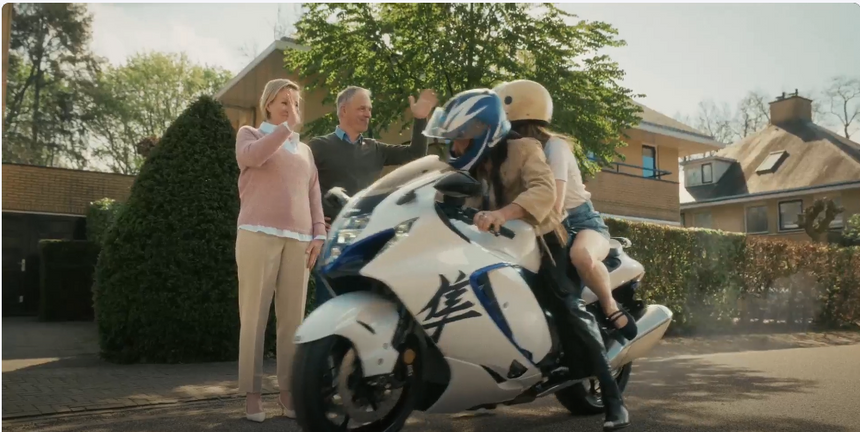

Bare legs on the back of a motorcycle: is that acceptable in an ad? The Lebara case explores the line between depicting risky behavior and encouraging it.
In a television commercial for Lebara, a young woman introduces her new boyfriend to her parents. With his long hair and motorcycle jacket, he does not exactly appear to be their ideal son-in-law at first: her respectable parents look visibly sceptical. Until he tells them that he is a Lebara customer. As if by magic, all their reservations disappear and the parents enthusiastically embrace him. Moments later, they wave the couple goodbye as their daughter gets on the back of his motorcycle with bare legs. As the motorcycle pulls away, the mother is briefly startled by the sound of the engine.
That final scene prompted two complaints to the Dutch Advertising Code Committee (Reclame Code Commissie, “RCC”). According to the complainants, the commercial set an irresponsible example by showing people riding a motorcycle without full protective clothing. The RCC assessed the complaints under the rules on good taste and decency and the public interest (Articles 2 and 3 of the Dutch Advertising Code (Nederlandse Reclame Code, “NRC”)).
In its defence, Lebara emphasised that protective motorcycle clothing is important from a safety perspective. Even so, Lebara argued, this did not make the commercial contrary to the NRC. Both riders are wearing the legally required helmets; additional protective clothing, while advisable, is not legally required. Moreover, the commercial contains no message about motorcycling or protective clothing and does not encourage dangerous behaviour. Lebara also pointed to the clearly humorous and unrealistic context of the commercial.
In line with Lebara’s defence, the RCC rejects both complaints. When applying the subjective standards of Articles 2 and 3 NRC, the RCC exercises restraint: it will only intervene if there is a pressing social need to stop broadcasting the advertisement. The RCC finds no such need here. In line with previous decisions, it holds that merely showing potentially risky behaviour is not sufficient. Although wearing protective motorcycle clothing is advisable from a safety perspective, its absence does not automatically make the commercial unacceptable. According to the RCC, the commercial is unmistakably humorous and does not convey the message that viewers should imitate the situation shown.
Notably, Lebara subsequently amended the commercial of its own accord by having the woman wear protective motorcycle trousers in the relevant scene, without being required to do so.
The decisions confirm a useful principle for advertisers: showing risky behaviour is not the same as encouraging it. Context and the message conveyed by the advertisement are key. If an advertisement does convey the message that dangerous behaviour should be imitated, it may cross the line of what is permissible.
Lisa Peek and Myrna Teeuw, both lawyers at Hoogenraad & Haak, represented Lebara in these proceedings.
/Passle/64ee09bf0948529fbac8c1a7/MediaLibrary/Images/2026-10-08-13-16-13-840-6ac7979dcd43704a2ddfc05c.jpg)
/Passle/64ee09bf0948529fbac8c1a7/MediaLibrary/Images/2026-10-08-13-04-52-099-6ac794f47241551f573f4e9d.jpg)
/Passle/64ee09bf0948529fbac8c1a7/MediaLibrary/Images/2026-06-29-12-27-18-418-6a4264a68e4e1e56ea2e4743.jpg)